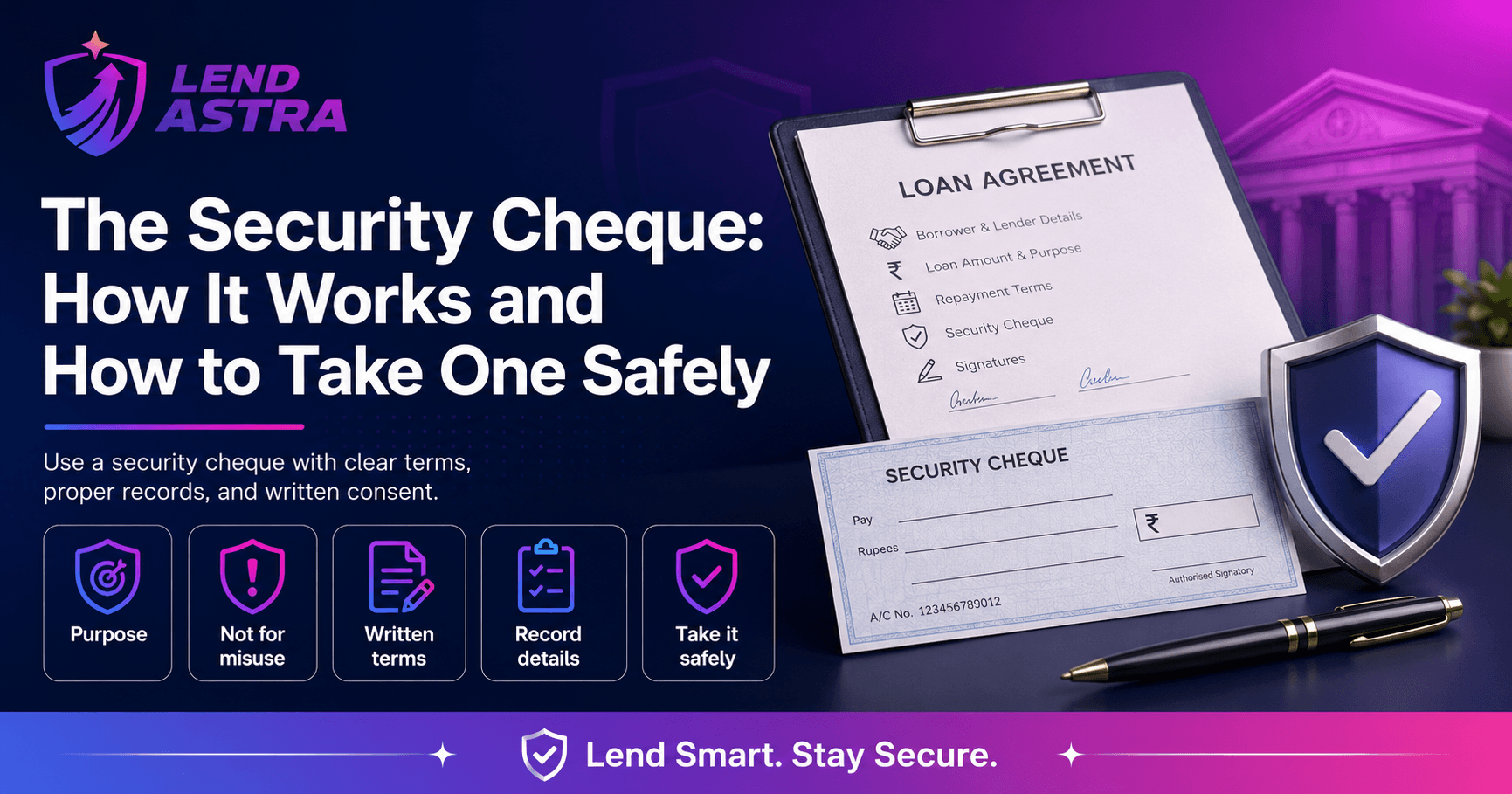
Ask any experienced private lender what they take before handing over a significant sum, and the answer is almost always the same: a security cheque. It is cheap, it is simple, and it carries a legal weight far beyond its appearance. It is also widely misunderstood, by lenders who think it is a magic guarantee and by borrowers who fear it is a trap. The truth sits sensibly in between.
What a security cheque actually does
A security cheque is a cheque the borrower gives the lender at the start, not to be banked immediately, but held against default. Its power comes from Section 138 of the Negotiable Instruments Act, which makes the dishonour of a cheque issued towards a debt a criminal offence, with a fast, well-defined process and the possibility of penalty up to twice the amount.
This is why it works. A civil recovery suit is slow. A bounced security cheque opens a quicker, sharper route, and the mere existence of that route changes how seriously a borrower treats repayment.
How to take one safely, as a lender
The cheque is only useful if it is valid when you need it. Take it signed and dated, with the amount filled in to match the loan. Confirm the account is active. And crucially, tie the cheque to the loan in writing: your agreement should record the cheque number and state that it is held as security for this specific loan. An undocumented cheque floating with no context is far weaker than one anchored to a written agreement.
How to give one safely, as a borrower
A security cheque is not a confession or a blank cheque to be misused. Protect yourself by ensuring the agreement states clearly that the cheque is security for this loan only, for this amount, and is to be returned on full repayment. That single clause stops the cheque from ever being used for more than it was meant to. Insist on getting it back, and on a receipt, the day you repay.
The line that matters
Write the purpose into the agreement, not on the cheque face. The agreement should say, in plain words, that cheque number so-and-so for ₹X is held purely as security for the loan dated such-and-such, and will be returned uncashed upon full repayment. That sentence protects the borrower from misuse and the lender from a "this was a gift" defence at the same time.
A Navi Mumbai example
In 2026 a Nerul lender advanced ₹3,00,000 against a security cheque. The agreement recorded the cheque number and the exact clause: held as security for this loan, returnable on full repayment. The borrower paid in three instalments. On the final payment, the lender returned the cheque and signed a one-line receipt confirming closure. The cheque was never banked. It did its entire job by simply existing, giving the lender the confidence to lend and the borrower a clear, bounded commitment.
A security-cheque checklist
- Take the cheque signed, dated, and matching the loan amount.
- Record the cheque number and its purpose in the written agreement.
- State clearly it is security for this loan only, returnable on repayment.
- Borrower: insist on getting it back, with a receipt, on full payment.
- Never use the cheque for anything beyond the documented loan.
Small paper, large protection
A security cheque is the rare instrument that protects both sides at once when it is documented properly. For the lender, it is a fast lane to recovery that most borrowers will work hard to avoid needing. For the borrower, a well-worded clause keeps it strictly bounded to the loan it secures. Anchored to a clear one-page agreement, it is one of the cheapest and strongest pieces of protection in all of personal lending.
%22%2F%3E%3Ctext%20x%3D%2264%22%20y%3D%22140%22%20fill%3D%22%23EFB33D%22%20font-family%3D%22system-ui%2CSegoe%20UI%2CArial%2Csans-serif%22%20font-size%3D%2226%22%20font-weight%3D%22700%22%20letter-spacing%3D%224%22%3ELEND%20ASTRA%3C%2Ftext%3E%3Ctext%20x%3D%2264%22%20y%3D%22300%22%20fill%3D%22%23F5F1E8%22%20font-family%3D%22system-ui%2CSegoe%20UI%2CArial%2Csans-serif%22%20font-size%3D%2250%22%20font-weight%3D%22800%22%3E%3Ctspan%20x%3D%2264%22%20dy%3D%220%22%3ENotarisation%2C%3C%2Ftspan%3E%3Ctspan%20x%3D%2264%22%20dy%3D%2258%22%3ERegistration%2C%20and%3C%2Ftspan%3E%3Ctspan%20x%3D%2264%22%20dy%3D%2258%22%3EE-Stamping%3A%20When%20Your%3C%2Ftspan%3E%3C%2Ftext%3E%3C%2Fsvg%3E)
%22%2F%3E%3Ctext%20x%3D%2264%22%20y%3D%22140%22%20fill%3D%22%23EFB33D%22%20font-family%3D%22system-ui%2CSegoe%20UI%2CArial%2Csans-serif%22%20font-size%3D%2226%22%20font-weight%3D%22700%22%20letter-spacing%3D%224%22%3ELEND%20ASTRA%3C%2Ftext%3E%3Ctext%20x%3D%2264%22%20y%3D%22300%22%20fill%3D%22%23F5F1E8%22%20font-family%3D%22system-ui%2CSegoe%20UI%2CArial%2Csans-serif%22%20font-size%3D%2250%22%20font-weight%3D%22800%22%3E%3Ctspan%20x%3D%2264%22%20dy%3D%220%22%3ERenewing%20or%20Extending%20a%3C%2Ftspan%3E%3Ctspan%20x%3D%2264%22%20dy%3D%2258%22%3ELoan%3A%20Documenting%20a%3C%2Ftspan%3E%3Ctspan%20x%3D%2264%22%20dy%3D%2258%22%3ERollover%20Cleanly%3C%2Ftspan%3E%3C%2Ftext%3E%3C%2Fsvg%3E)