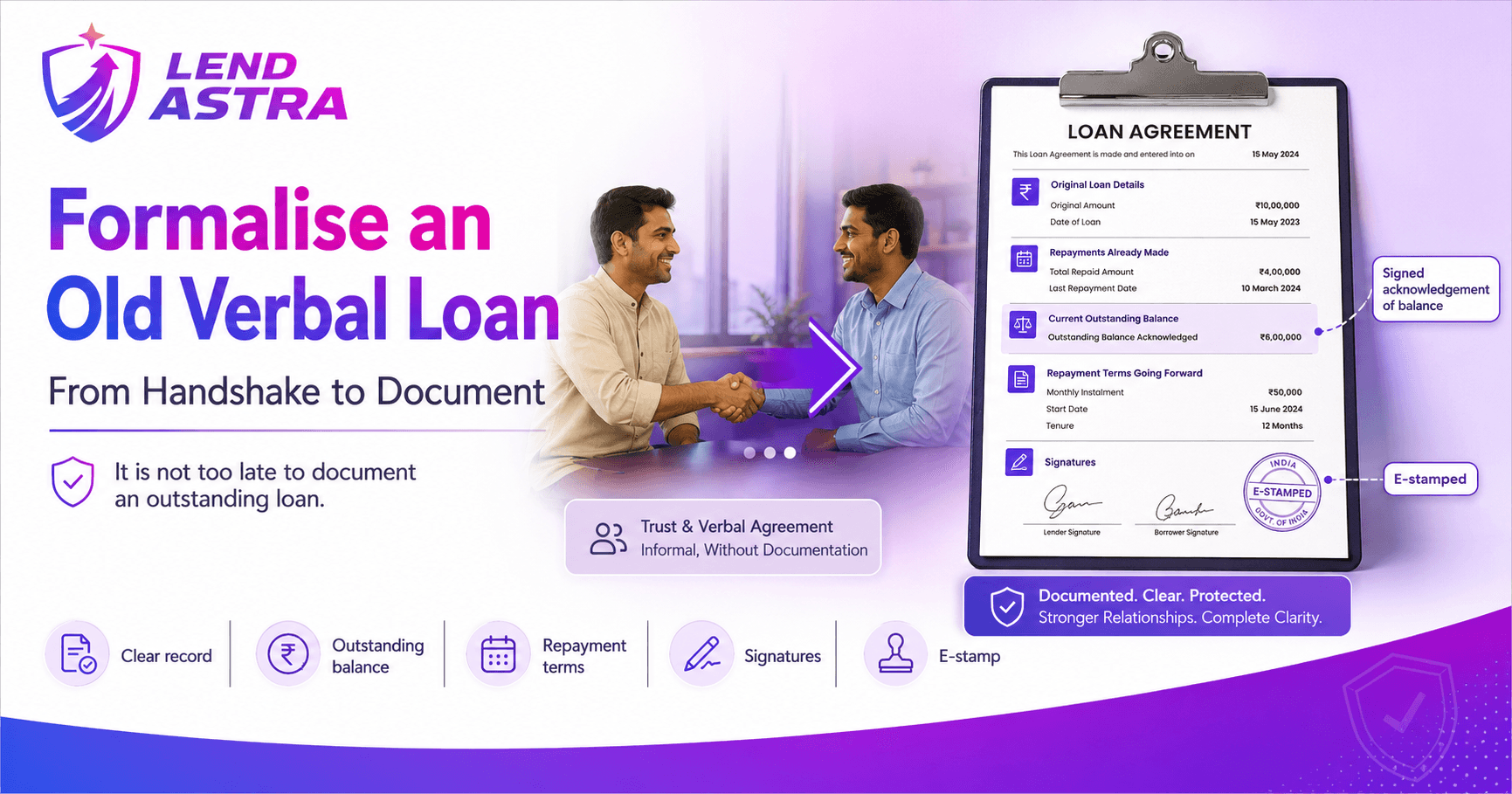
Plenty of good advice tells you to document a loan before the money moves. But what about the loan you already made, on trust, with nothing written, perhaps a year ago, that is still outstanding. Many people assume that ship has sailed, that you cannot document something after the fact. You can, and you should. Formalising an existing verbal loan is one of the most useful and least understood moves in personal lending, and it is rarely too late to do it well.
It is genuinely not too late
A loan does not become unrecordable just because it started as a handshake. At any point while it is outstanding, the two parties can agree to put their existing understanding into writing. This is not creating a fiction; it is documenting a reality that already exists. The money was lent, it is owed, and writing that down now is simply giving an existing fact the clear form it should have had from the start.
Why doing it now matters
There are two strong reasons to formalise an old loan rather than leave it floating. The first is protection: a written acknowledgement of the debt converts a vague, hard-to-prove arrangement into a clear, evidenced one, and crucially, a written acknowledgement also refreshes the limitation clock, restoring your window to recover if it ever comes to that. The second is relational: a loan that has drifted without terms is a quiet source of unease for both, and pinning it down calmly often relieves a tension neither party had quite named.
How to raise it without awkwardness
The key is framing it as tidying up, not as suddenly distrusting an old friend. The honest, easy approach is something like: "I realised we never put our loan on paper, and I think it would be good for both of us to have a clear record, just so neither of us has to rely on memory." Most people respond well, because deep down an undocumented debt makes them uneasy too. You are not accusing them. You are offering both of you clarity.
What to write down
The document for an old loan is much like any other, adjusted for where things stand. Record the original amount and date as accurately as you both recall, any repayments already made and the current outstanding balance, the agreed terms going forward, including any interest and a repayment date, and both signatures. The single most valuable element is the borrower's acknowledgement of the current balance, which anchors everything and refreshes your legal standing. E-stamp it, and you have turned a handshake into a proper agreement.
A Navi Mumbai example
In 2026 a Belapur resident realised that a ₹1,50,000 loan he had given a friend eighteen months earlier was still outstanding with nothing on paper, and the vagueness had quietly cooled things between them. Rather than let it fester, he raised it gently as tidying up. The two sat down and wrote a simple page: the original amount and date, the ₹50,000 already repaid, the ₹1,00,000 still outstanding acknowledged by the friend, a fair repayment schedule for the balance, and both signatures, e-stamped. The acknowledgement refreshed the limitation clock, the terms were finally clear, and, to both their surprise, the friendship warmed again once the unspoken debt became a settled plan.
A formalising checklist
- An outstanding verbal loan can be documented at any time; it is not too late.
- A written acknowledgement of the balance refreshes the limitation clock.
- Frame it as tidying up for mutual clarity, not as new distrust.
- Record the original amount, repayments made, current balance, and terms going forward.
- Get the borrower's signed acknowledgement of the outstanding balance, and e-stamp it.
Give an old loan the form it deserves
The loan you made on trust was a good thing, and documenting it now does not diminish that trust; it honours it by making sure the kindness never curdles into a dispute. It is never too late to turn a handshake into a clear page. Doing so protects your money, refreshes your legal standing, and very often quietly mends a relationship that an unspoken debt had strained. The best time to document a loan was at the start. The second best time, as with so many good things, is now.
%22%2F%3E%3Ctext%20x%3D%2264%22%20y%3D%22140%22%20fill%3D%22%23EFB33D%22%20font-family%3D%22system-ui%2CSegoe%20UI%2CArial%2Csans-serif%22%20font-size%3D%2226%22%20font-weight%3D%22700%22%20letter-spacing%3D%224%22%3ELEND%20ASTRA%3C%2Ftext%3E%3Ctext%20x%3D%2264%22%20y%3D%22300%22%20fill%3D%22%23F5F1E8%22%20font-family%3D%22system-ui%2CSegoe%20UI%2CArial%2Csans-serif%22%20font-size%3D%2250%22%20font-weight%3D%22800%22%3E%3Ctspan%20x%3D%2264%22%20dy%3D%220%22%3ENotarisation%2C%3C%2Ftspan%3E%3Ctspan%20x%3D%2264%22%20dy%3D%2258%22%3ERegistration%2C%20and%3C%2Ftspan%3E%3Ctspan%20x%3D%2264%22%20dy%3D%2258%22%3EE-Stamping%3A%20When%20Your%3C%2Ftspan%3E%3C%2Ftext%3E%3C%2Fsvg%3E)
%22%2F%3E%3Ctext%20x%3D%2264%22%20y%3D%22140%22%20fill%3D%22%23EFB33D%22%20font-family%3D%22system-ui%2CSegoe%20UI%2CArial%2Csans-serif%22%20font-size%3D%2226%22%20font-weight%3D%22700%22%20letter-spacing%3D%224%22%3ELEND%20ASTRA%3C%2Ftext%3E%3Ctext%20x%3D%2264%22%20y%3D%22300%22%20fill%3D%22%23F5F1E8%22%20font-family%3D%22system-ui%2CSegoe%20UI%2CArial%2Csans-serif%22%20font-size%3D%2250%22%20font-weight%3D%22800%22%3E%3Ctspan%20x%3D%2264%22%20dy%3D%220%22%3ERenewing%20or%20Extending%20a%3C%2Ftspan%3E%3Ctspan%20x%3D%2264%22%20dy%3D%2258%22%3ELoan%3A%20Documenting%20a%3C%2Ftspan%3E%3Ctspan%20x%3D%2264%22%20dy%3D%2258%22%3ERollover%20Cleanly%3C%2Ftspan%3E%3C%2Ftext%3E%3C%2Fsvg%3E)
%22%2F%3E%3Ctext%20x%3D%2264%22%20y%3D%22140%22%20fill%3D%22%23EFB33D%22%20font-family%3D%22system-ui%2CSegoe%20UI%2CArial%2Csans-serif%22%20font-size%3D%2226%22%20font-weight%3D%22700%22%20letter-spacing%3D%224%22%3ELEND%20ASTRA%3C%2Ftext%3E%3Ctext%20x%3D%2264%22%20y%3D%22300%22%20fill%3D%22%23F5F1E8%22%20font-family%3D%22system-ui%2CSegoe%20UI%2CArial%2Csans-serif%22%20font-size%3D%2250%22%20font-weight%3D%22800%22%3E%3Ctspan%20x%3D%2264%22%20dy%3D%220%22%3EGuarantors%20and%3C%2Ftspan%3E%3Ctspan%20x%3D%2264%22%20dy%3D%2258%22%3ECo-Signers%20in%20Personal%3C%2Ftspan%3E%3Ctspan%20x%3D%2264%22%20dy%3D%2258%22%3ELoans%3A%20Rights%2C%20Risks%2C%3C%2Ftspan%3E%3C%2Ftext%3E%3C%2Fsvg%3E)