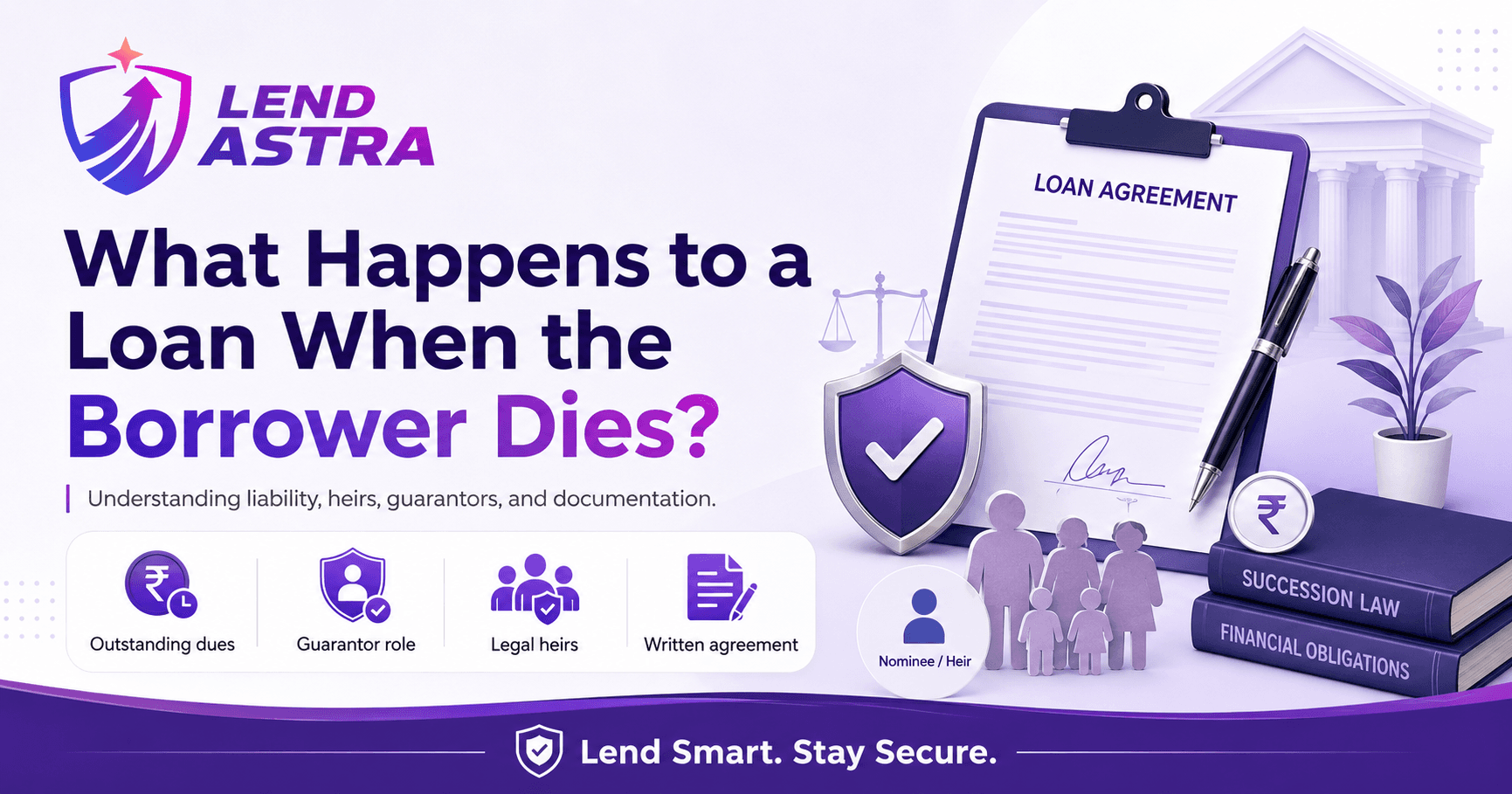
It is the question no one wants to ask when they lend to a friend or relative, and exactly the one that catches families off guard. If the borrower passes away before repaying, does the loan simply vanish? The short answer is no. A debt is part of a person's estate, and it does not disappear with them. But recovering it has rules, limits, and one absolute requirement: proof.
A debt survives, within the estate
When someone dies, their assets and their liabilities pass together to their estate. A genuine, documented loan is a liability of that estate, and the lender becomes a creditor of it. This means the loan can, in principle, be recovered from what the deceased left behind, before the heirs inherit what remains.
The key idea is that heirs inherit the net estate. They take what is left after legitimate debts are accounted for, not the assets free and clear with the debts ignored.
The limit of an heir's liability
This is the part that protects families. Under Indian succession principles, legal heirs are liable for a deceased's debts only to the extent of the estate they inherit. An heir is not personally on the hook beyond what they received. If the borrower left ₹3,00,000 in assets and a ₹3,00,000 debt, the debt can absorb the estate, but the heirs do not pay from their own pockets if the estate falls short.
So a lender recovers from the estate, not from the heirs personally. That distinction is both the lender's route and the family's shield.
Why documentation is everything here
In life, an informal loan can sometimes be sorted out by a conversation. In death, that option is gone. The borrower cannot confirm the debt, and grieving heirs may genuinely not know it existed. Without a document, the lender is left trying to prove a loan to people who never agreed to it, often against the natural suspicion that follows money claims after a death.
A clear written agreement changes the entire situation. It establishes the debt as a fact, not a claim, allowing it to be presented to the estate calmly and credibly. This is the scenario where an undocumented loan most often becomes unrecoverable, and a documented one stays safe.
A Navi Mumbai example
In 2026 a Panvel lender had advanced ₹2,50,000 to a friend on a clear one-page agreement with a security cheque. When the friend passed away unexpectedly, the lender did not have to argue with the bereaved family from a position of suspicion. He presented the signed, e-stamped agreement to the family, who could see plainly that the debt was real. It was settled from the estate over a few months, with dignity on both sides. The document turned what could have been a bitter, doubtful dispute into a clear, respectful settlement.
A checklist for this difficult case
- A documented loan survives the borrower as a debt of the estate.
- The lender recovers from the estate, before heirs inherit the remainder.
- Heirs are liable only up to the value of what they inherit, not personally beyond it.
- Without a document, proving the loan after a death is extremely hard.
- A security cheque and a clear agreement keep recovery dignified and possible.
Document for the day you hope never comes
No one lends to a friend imagining their death. But it is precisely the unthinkable case that exposes whether a loan was real on paper or only in memory. A clear, signed, stamped agreement does more than protect your money. It protects a grieving family from a doubtful, painful dispute, letting a genuine debt be settled from the estate calmly and fairly. It is the kindest paperwork you will ever do.
%22%2F%3E%3Ctext%20x%3D%2264%22%20y%3D%22140%22%20fill%3D%22%23EFB33D%22%20font-family%3D%22system-ui%2CSegoe%20UI%2CArial%2Csans-serif%22%20font-size%3D%2226%22%20font-weight%3D%22700%22%20letter-spacing%3D%224%22%3ELEND%20ASTRA%3C%2Ftext%3E%3Ctext%20x%3D%2264%22%20y%3D%22300%22%20fill%3D%22%23F5F1E8%22%20font-family%3D%22system-ui%2CSegoe%20UI%2CArial%2Csans-serif%22%20font-size%3D%2250%22%20font-weight%3D%22800%22%3E%3Ctspan%20x%3D%2264%22%20dy%3D%220%22%3EMediation%20Over%3C%2Ftspan%3E%3Ctspan%20x%3D%2264%22%20dy%3D%2258%22%3ELitigation%3A%20Resolving%3C%2Ftspan%3E%3Ctspan%20x%3D%2264%22%20dy%3D%2258%22%3ELoan%20Disputes%20Without%3C%2Ftspan%3E%3C%2Ftext%3E%3C%2Fsvg%3E)
%22%2F%3E%3Ctext%20x%3D%2264%22%20y%3D%22140%22%20fill%3D%22%23EFB33D%22%20font-family%3D%22system-ui%2CSegoe%20UI%2CArial%2Csans-serif%22%20font-size%3D%2226%22%20font-weight%3D%22700%22%20letter-spacing%3D%224%22%3ELEND%20ASTRA%3C%2Ftext%3E%3Ctext%20x%3D%2264%22%20y%3D%22300%22%20fill%3D%22%23F5F1E8%22%20font-family%3D%22system-ui%2CSegoe%20UI%2CArial%2Csans-serif%22%20font-size%3D%2250%22%20font-weight%3D%22800%22%3E%3Ctspan%20x%3D%2264%22%20dy%3D%220%22%3ENRI%20Lending%20to%20Family%20in%3C%2Ftspan%3E%3Ctspan%20x%3D%2264%22%20dy%3D%2258%22%3EIndia%3A%20The%20FEMA%20Basics%3C%2Ftspan%3E%3C%2Ftext%3E%3C%2Fsvg%3E)
%22%2F%3E%3Ctext%20x%3D%2264%22%20y%3D%22140%22%20fill%3D%22%23EFB33D%22%20font-family%3D%22system-ui%2CSegoe%20UI%2CArial%2Csans-serif%22%20font-size%3D%2226%22%20font-weight%3D%22700%22%20letter-spacing%3D%224%22%3ELEND%20ASTRA%3C%2Ftext%3E%3Ctext%20x%3D%2264%22%20y%3D%22300%22%20fill%3D%22%23F5F1E8%22%20font-family%3D%22system-ui%2CSegoe%20UI%2CArial%2Csans-serif%22%20font-size%3D%2250%22%20font-weight%3D%22800%22%3E%3Ctspan%20x%3D%2264%22%20dy%3D%220%22%3ERecovering%20a%20Loan%20Across%3C%2Ftspan%3E%3Ctspan%20x%3D%2264%22%20dy%3D%2258%22%3EStates%3A%20Jurisdiction%20and%3C%2Ftspan%3E%3Ctspan%20x%3D%2264%22%20dy%3D%2258%22%3EWhere%20to%20File%3C%2Ftspan%3E%3C%2Ftext%3E%3C%2Fsvg%3E)